The Wall
You’ve had this moment. A clear idea in your head — a book, a website, a product, a research project — and between that idea and reality, there’s an invisible wall.
It’s not a talent problem. It’s a tooling problem.
You want to write a novel but don’t know how to typeset. You want to build a website but can’t code. You want to validate a business idea but don’t know where to start.
You have the wish. You lack the path to fulfillment.
Wish and Fulfillment
In Chinese, “心想事成” (xīn xiǎng shì chéng) means “what the heart wishes, reality becomes.” Break it apart:
- 心想 (Wish): What do you truly want? How do you know when it’s done?
- 事成 (Fulfillment): The journey from intention to result.
Most tools solve pieces of fulfillment — they help you code, design, or format. But no tool solves the fundamental problem: you define the wish, and fulfillment happens automatically.
That’s what Ruyi does.
The Dumbest Method That Works
The core principle behind Ruyi is almost suspiciously simple:
Loop + Input = Compression
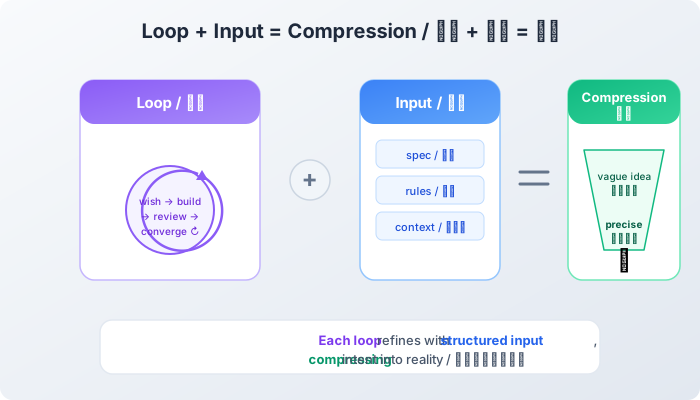
You have a vague idea. Ruyi turns it into a precise result. Not through a single flash of genius, but through relentless iteration:
- Wish — You describe what you want
- Build — AI executes
- Review — A separate AI evaluates the result
- Converge — Refine based on feedback, loop again
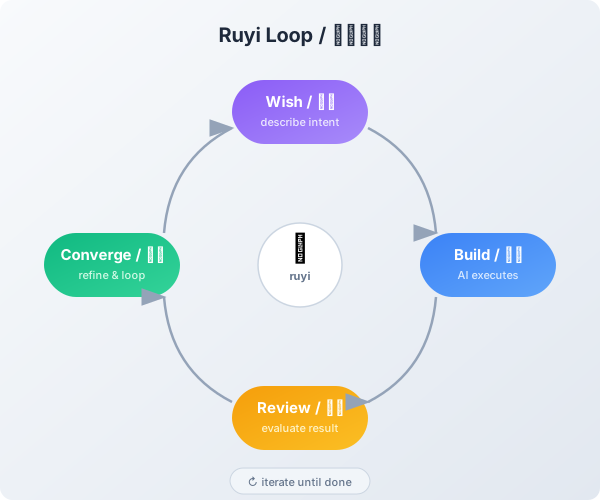
Each loop brings the result closer to your wish. Like kneading dough — each fold makes the shape more precise.
This is compression. Compressing vague intent into precise reality.
Is this method dumb? Yes. Is it effective? Extremely. Because this is what AI fundamentally is — compression. As long as there’s a loop and input, there’s compression. No shortcuts needed. No magic required.
From Waterfall to Agile to Ruyi
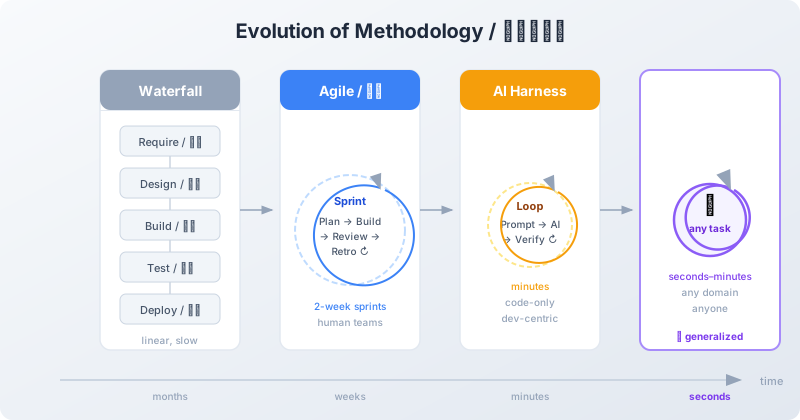
The software industry has spent decades solving one problem: how to keep projects from spiraling out of control.
Projects fail for one reason: divergence. Scope creeps, requirements shift, direction gets lost.
To fight divergence, the industry developed methodology after methodology:
- Waterfall: Plan everything upfront, then execute linearly. The problem — you can never plan everything upfront.
- Agile: Don’t plan that far ahead. Every two weeks: plan, build, review, reflect. Effective, but requires an entire team.
- AI Harness: Replace the team with AI agents, shrink the loop to minutes. But still limited to coding.
Strip away the jargon, and every one of these is the same pattern: do a little, check it, do a little more. The dev-review loop.
Karpathy’s autoresearch proved this loop works for research — run experiments, evaluate, iterate until values converge. AI harnesses proved it works for coding.
Ruyi generalizes it: the loop works for everything.
Why You Don’t Need to Know How It Works
Under the hood, Ruyi uses git (version control), Claude Code (AI engine), dual-agent adversarial review, and a Racket-based safety layer.
You don’t need to know any of that.
Just like you don’t need to know how the chip in your phone works to make a call.
Previous AI tools share a common flaw: they assume the user is technical. You need to install software, use a terminal, understand what “git commit” means. These aren’t ordinary skills — they’re professional barriers.
Ruyi hides all of it. For you, there’s exactly one thing:
ruyi do
Tell it what you want. It asks a few questions to clarify your wish. Then it works — building, reviewing, refining — until it’s done.
Who Ruyi Is For
Ruyi wasn’t built for programmers (though programmers can use it too).
Ruyi was built for people with ideas:
- You’re a writer who wants to turn a manuscript into a beautiful ebook site
- You’re a designer who wants to turn a concept into a working prototype
- You’re a philosopher who wants to structure thoughts into a coherent essay series
- You’re an entrepreneur who wants to rapidly validate a product concept
- You’re a teacher who wants to create personalized learning materials
What you all share: you know what you want, but lack the toolchain to make it real.
Ruyi is that toolchain. And it’s the shortest one possible — just two words: ruyi do.
Get Started
Set up a machine with Claude Code, then:
# Install Ruyi
# Paste this into Claude Code:
# "Please install ruyi, refer to https://github.com/ZhenchongLi/ruyi"

# Then, as you wish
ruyi do
Ruyi will ask: what do you want to do?
Answer it. The loop handles the rest.
Ruyi (如意) means “as you wish.” Inspired by Andrej Karpathy’s autoresearch — using iterative convergence to solve research problems. Ruyi generalizes the idea: not just research, not just code, but anything with a clear goal.
Repository: github.com/ZhenchongLi/ruyi